

A recent systematic review on sleep and learning in physician trainees reported that sleep deprivation exerts a substantial negative influence on the acquisition of new skills, a finding that resonates beyond medical education into motor learning domains relevant to athletic training. The mechanisms proposed include impaired memory consolidation during slow-wave and REM sleep, as well as reduced attentional capacity during subsequent waking hours. While the population under study consisted of medical residents rather than athletes, the neurocognitive pathways involved in procedural memory overlap considerably with those engaged during technical skill development in sport. This suggests that chronic sleep restriction could attenuate the rate at which a lifter refines movement patterns under load, though direct experimental evidence in resistance-trained cohorts is lacking.
Sleep Architecture and Recovery Physiology
The restorative functions of sleep are often partitioned into non-REM stages, where growth hormone secretion peaks, and REM sleep, associated with neural reorganization. A meta-analysis of behavioral sleep interventions in adolescents and emerging adults found that total sleep time could be increased by approximately 30 minutes per night through cognitive-behavioral strategies, with a standardized mean difference of 0.4 relative to controls. Sleep efficiency, measured via actigraphy, also improved modestly. These effect sizes, while statistically significant, leave open the question of whether such gains translate into meaningful physiological recovery for athletes. The dose required to shift anabolic hormone profiles or reduce inflammatory markers may exceed the increments typically achieved in intervention studies, and the heterogeneity of protocols complicates extrapolation.
Exercise as a Sleep-Promoting Stimulus
The reverse direction — exercise influencing sleep — has received more empirical attention. A systematic review encompassing both acute and chronic exercise paradigms noted that the effects of regular training on sleep architecture in adults are inconsistent, with some studies reporting increased slow-wave sleep and others finding no change. The variability may stem from differences in exercise modality, timing, and participant fitness levels. A more focused meta-analysis of 16 randomized trials in adult women demonstrated that exercise training significantly reduced global Pittsburgh Sleep Quality Index scores, with a pooled effect that favored interventions lasting less than 12 weeks for improving daytime dysfunction, while programs extending beyond 12 weeks were associated with reduced reliance on sleep medication. This temporal dissociation hints at distinct mechanisms: shorter interventions may alleviate subjective sleep complaints through mood enhancement or circadian entrainment, whereas longer programs might address underlying sleep pathologies that drive medication use.
Sleep Apnea, Exercise, and Training Implications
Sleep-disordered breathing presents a confound in the sleep-training relationship, particularly in populations with elevated body mass. A meta-analysis of exercise training on sleep apnea indices reported a decrease in apnea-hypopnea index of roughly -0.54 events per hour (95% CI: -0.87 to -0.21) and a reduction in Epworth Sleepiness Scale scores of -1.25 points (95% CI: -2.46 to -0.04). The effect on AHI, while statistically significant, is modest and may not eliminate the need for continuous positive airway pressure therapy in moderate-to-severe cases. For athletes with undiagnosed sleep apnea, the interaction between training fatigue and nocturnal hypoxia could blunt recovery adaptations, though no trials have specifically examined resistance training outcomes in this subgroup. The heterogeneity in AHI response across studies — I² of 20% — suggests that individual factors such as craniofacial anatomy and baseline sleep architecture modulate the benefit.
Practical Application for Training Populations
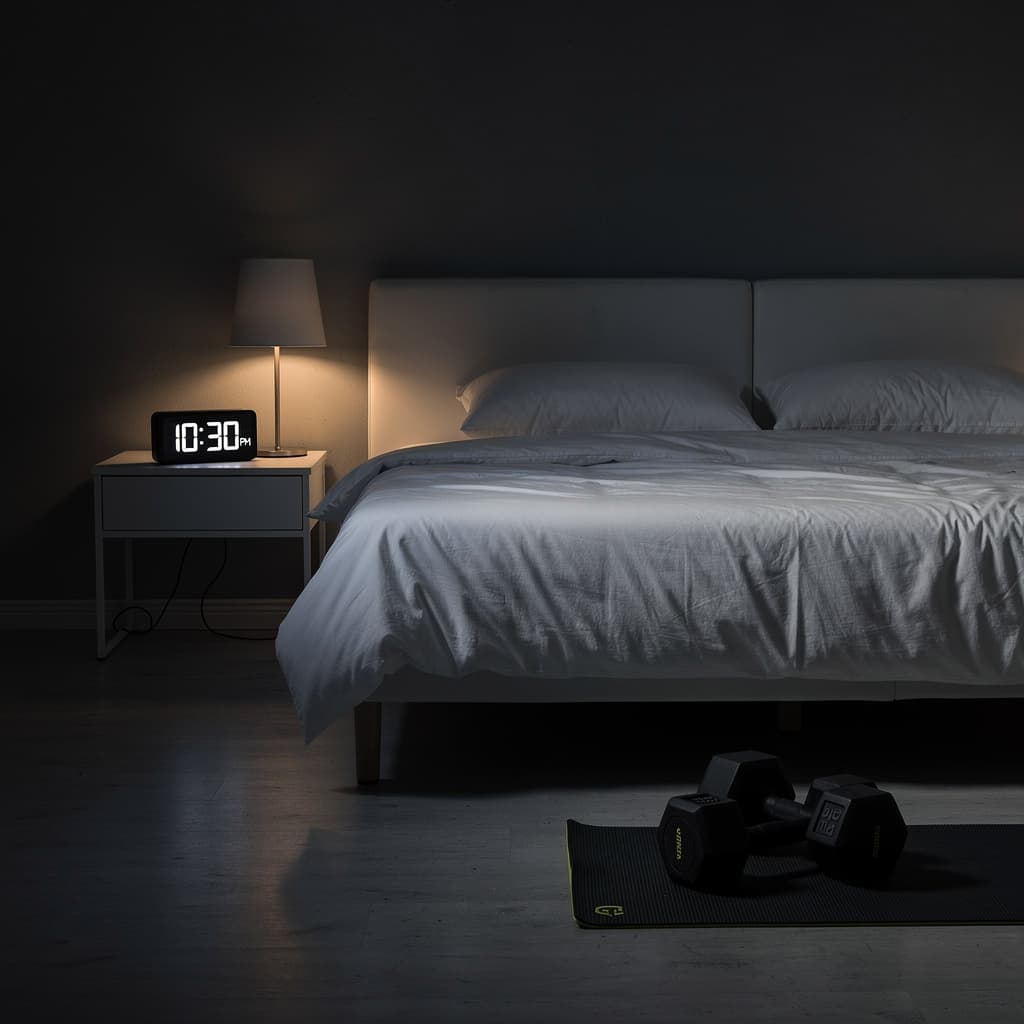
Given the asymmetrical evidence base, the practitioner’s approach to sleep optimization should be tiered. First, screening for sleep disorders via validated questionnaires like the STOP-Bang can identify individuals who may require polysomnography before attributing poor recovery to training variables. Second, behavioral strategies shown to increase total sleep time in non-clinical samples — consistent bedtimes, pre-sleep routines, and limiting evening light exposure — can be implemented with minimal burden. Third, the timing of training relative to sleep onset warrants consideration: vigorous exercise within 60 minutes of bedtime may elevate core temperature and delay sleep onset in some individuals, though the effect is not uniform. The meta-analytic data do not support a blanket recommendation to avoid evening training, but athletes who report difficulty initiating sleep after late sessions may benefit from a 90-minute buffer.
Caveats and Limitations
Several constraints temper the interpretation of these findings. The majority of sleep intervention trials have been conducted in non-athlete populations, limiting generalizability to trained individuals whose recovery demands differ. The Pittsburgh Sleep Quality Index, while widely used, captures subjective sleep quality over a one-month window and may not reflect night-to-night variability relevant to training microcycles. Objective measures such as polysomnography remain rare in exercise studies due to cost and participant burden. Furthermore, the dose-response relationship between sleep duration and specific training outcomes — strength, hypertrophy, power — has not been characterized in randomized designs. Most evidence is observational, and residual confounding by stress, nutrition, or training load cannot be excluded. The meta-analytic estimate for sleep apnea improvement, derived from eight studies with 182 participants, underscores the need for larger, adequately powered trials before firm conclusions can be drawn.
Readers with personal sleep or training concerns should consult a physician for individualized guidance.
References
- Sleep and Learning: A Systematic Review — PubMed
- A Systematic Review and Meta-Analysis of Behavioral Sleep Interventions — PMC
- Interrelationship between Sleep and Exercise: A Systematic Review — PMC
- Effects of exercise on sleep quality in women - A systematic review and meta-analysis — PubMed
- Effect of exercise training on sleep apnea: A systematic review and meta-analysis — PubMed