


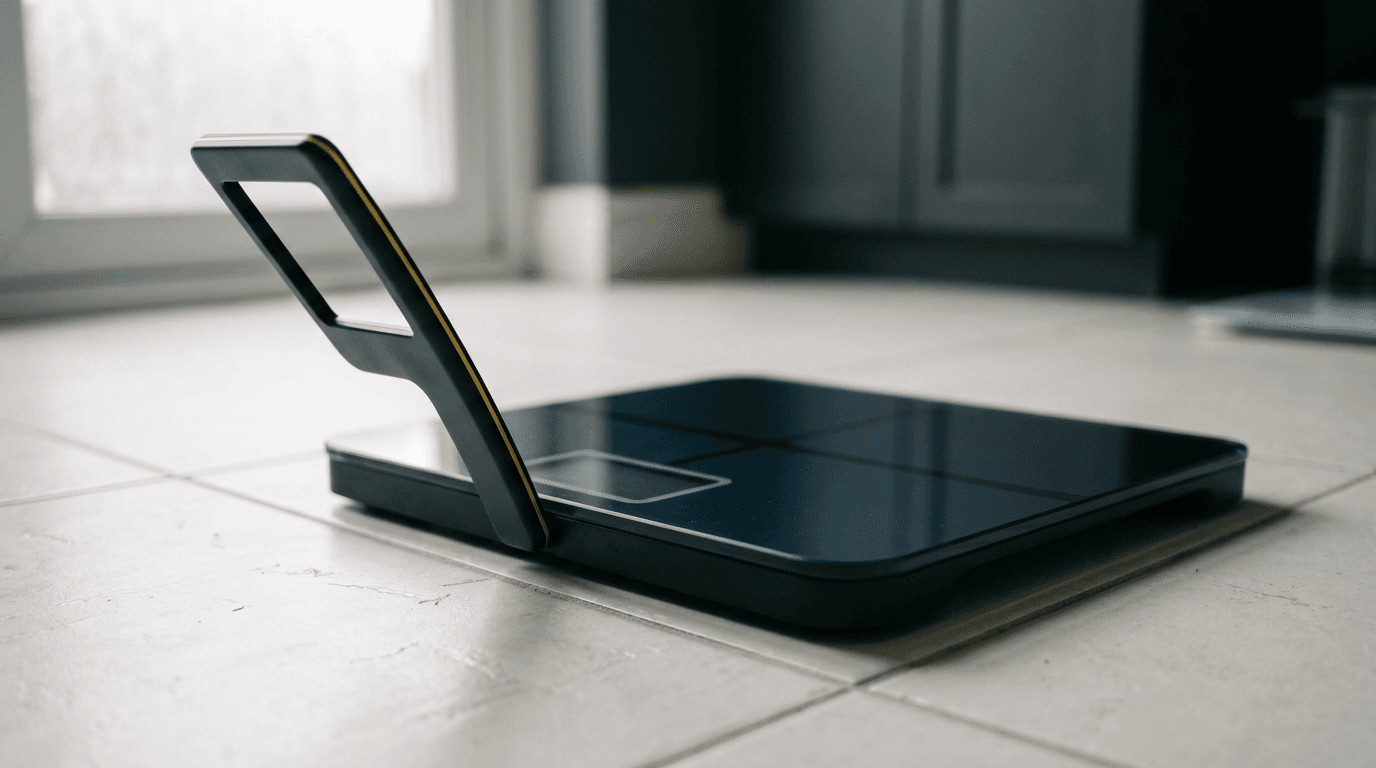
A smart scale is a bathroom scale that learned to guess. You step on it, it sends a tiny current through your feet, measures how much resistance that current meets, and turns the result into a body-fat percentage. Newer models add a retractable handle so the current can travel through your arms and torso as well. The pitch is a full body check in your socks. The reality is closer to a bathroom scale with opinions.
What it is
The category has shifted toward full-body scanners with handlebar electrodes, as WIRED noted in its roundup. These devices use bioelectrical impedance analysis, or BIA, to estimate body composition. The floor-only version sends current up one leg and down the other, so it mostly sees your lower half. The handle version completes a circuit through your upper body, which gives a more complete picture. Withings bundles several measurements into one standing scan: standing heart rate, nerve and arterial health, visceral fat. Some of those metrics carry regulatory clearance in Europe or the US; others do not. That distinction matters more than the marketing copy suggests. A smart scale is one tool among many, not the future of fitness.
How it works (in plain language)
BIA rests on a simple principle: muscle conducts electricity better than fat does. The scale sends a weak, imperceptible current through your body and measures the impedance. More resistance generally means more fat tissue in the path. Software combines that reading with your height, weight, age, and sex to produce a body-fat estimate. The handle adds a second path through your arms and torso, which is why the numbers can differ. WIRED's reviewer saw body-fat percentages swing up to six points between a floor-only scale and a handle model. That is not a small discrepancy. It is a reminder that the device is inferring, not measuring directly. Hydration, recent exercise, and even the time of day change how well your body conducts current.
Why it matters for movement and health
The useful part of a smart scale is not the absolute number. It is the trend. If you are lifting weights and eating enough protein, the scale can show body fat drifting down while weight holds steady — a signal you would miss with a plain scale. The Verge's Optimizer column made a similar point: accuracy in this context is overrated, because the value is in the pattern over weeks and months. A single reading after a salty dinner is noise. A line that moves in one direction across a season is information. For movement, that means you can check whether a training block is doing what you intended. For health, it means a rough gauge of composition changes a weight-only scale hides. Treat the score as a relative number, not a clinical reading.
Open caveats
The unsexy caveat is that these devices are inconsistent in ways the app does not advertise. Hydration status, food in your gut, and skin temperature all shift the impedance reading. The Verge's review of the Withings Body Smart noted a thoughtful approach but also flaws; the device records data without showing your weight on the display, which is a design choice, not a fix for accuracy. Privacy is the other open question. A scale that syncs to an app is a scale that sends your body composition to a server. Check what the company stores and whether you can export or delete it. And remember the handle models cost more for a second current path, not a clinical-grade scan. If the number disagrees with how you feel, trust the body.
FAQ
Why did my body-fat percentage jump overnight?
Because it isn't a measurement — it's an inference from impedance, and impedance moves with hydration, gut contents, and skin temperature. A salty dinner or a hard workout can shift the reading several points without a gram of fat changing. Weigh yourself under the same conditions and read the weekly average, not the morning number.
Is a handle model actually worth the extra money?
It buys you a second current path through your arms and torso, which gives a more complete estimate than the floor-only circuit. But as WIRED's reviewer found, the two can disagree by up to six points — so the handle doesn't make the number more clinical, just differently biased. Buy it for the trend, not the precision.
Should I trust the scale or how I feel?
How you feel, every time. The scale is a rough gauge of composition drifting in one direction over months; it is not a verdict on any given day. If the number and your body disagree, the number is the one that's guessing.