

A wrist-worn heart-rate monitor is not a lie detector, but it is also not a medical instrument. It shines a light into your skin, watches the way your blood swells and recedes, and guesses your pulse from the flicker. That guess is pretty good when you are sitting still. It gets worse when your arms are swinging, when your hands are cold, or when the rhythm of your feet confuses the sensor into locking onto your cadence instead of your heart. The device is reading a real signal; the question is how much noise is mixed in.
What it is
The category of beginner-friendly fitness tech includes anything that promises a low barrier to entry: wrist-based heart-rate trackers, AI posture apps that use your phone camera, smart scales that estimate body composition, and sleep trackers tucked into rings or mattresses. They share a common pitch—no manual required, just wear it or stand in front of it and the numbers will guide you. The pitch works because it is partly true. The sensors are real, the algorithms are improving, and the feedback arrives in seconds. The part that gets left out of the marketing is how often that feedback is wrong in ways that matter.
How it works (in plain language)
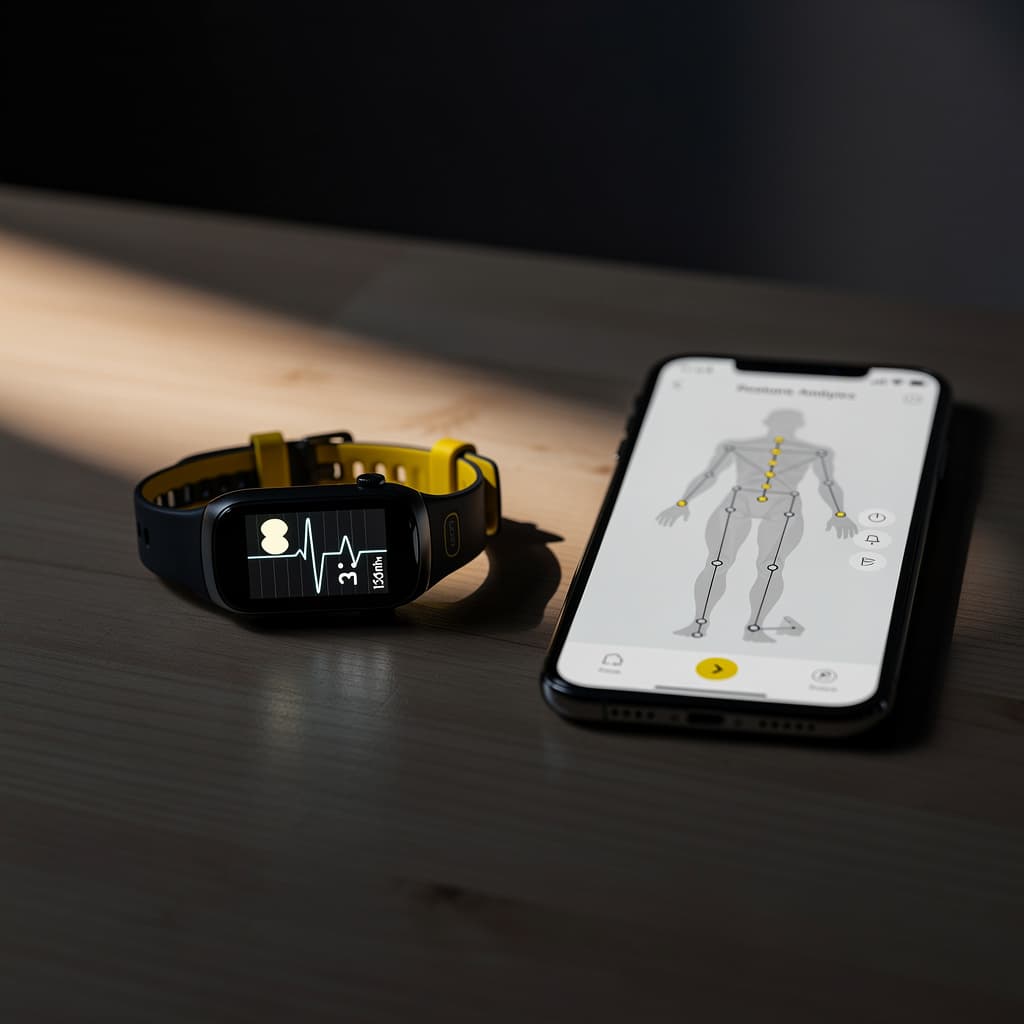
Most wrist-based heart-rate monitors use photoplethysmography, which is a long word for a tiny flashlight and a tiny camera pressed against your skin. The light bounces off your blood vessels, and the changes in brightness map onto your pulse. A similar principle shows up in smart rings, which add temperature and motion sensors to the mix. Posture apps use a different trick: the phone camera identifies about twenty landmarks on your body—shoulders, hips, knees—and compares the angles between them to a library of reference positions. The software flags deviations and suggests corrections, much like a mirror that never blinks.
Under the hood, these devices run machine-learning models trained on large datasets of labeled examples. The model learns to associate a certain pattern of light flicker with a heartbeat, or a certain arrangement of joints with a squat. Accuracy is often described with a top-k accuracy score, which counts a prediction as correct if the right answer appears anywhere in the model's top few guesses. That metric can make a model look better than it feels in daily use, because being right somewhere in the top five guesses is not the same as being right when you need a single number.
Why it matters for movement / health
For someone new to exercise, a little feedback can be genuinely useful. A heart-rate zone estimate can keep a brisk walk from turning into an accidental sprint. A posture app can catch the moment your hips start drifting forward during a plank, a mistake most beginners cannot feel on their own. Sleep trackers can reveal that your bedtime drifts by two hours every weekend, explaining why Monday mornings feel like a tax. These are real insights, and they do not require a degree to understand.
The danger is not that the tech is useless; it is that the tech is presented as authoritative. A beginner who sees a heart-rate reading of 150 beats per minute has no reason to doubt it, even if the true value is 130 and the sensor is just confused by a bumpy road. A posture app that flags a slight knee cave during a squat might send a new lifter down a rabbit hole of corrective exercises for a problem that does not exist. The device is a tool, not a teacher, and it lacks the context a human coach would bring: what you did yesterday, how you slept, whether you are stressed, whether that knee has always moved that way.
Open caveats
The accuracy gap is not a secret, but it is rarely spelled out in the app store description. Wrist-based heart-rate monitors struggle during interval training and any activity that involves gripping, because muscle tension changes the blood flow the sensor is trying to read. AI posture apps depend on lighting, camera angle, and the clothes you are wearing; baggy sweats can hide the landmarks the model needs. Sleep trackers are notoriously bad at distinguishing light sleep from wakefulness, with agreement against the gold-standard polysomnography often hovering around 60 percent for non-REM stages. That is fine for spotting trends over weeks, useless for diagnosing a sleep disorder.
There is also a privacy dimension that beginner-friendly marketing tends to skip. The posture app that sees your body is sending video frames to a server somewhere, and the privacy policy may allow that data to be used for training future models. The smart scale that knows your weight and estimated body-fat percentage is building a profile that could, in theory, be shared with insurance partners. These are not hypotheticals; they are the business models that make the hardware cheap. The trade-off might be worth it to you, but you cannot make that call if the trade-off is never mentioned.
Treat the score as a relative number, not a clinical reading. If your heart-rate monitor says 160 and you feel fine, trust the body. If your sleep score says 45 and you woke up feeling rested, trust the body. The most beginner-friendly tech is the one that teaches you to listen to yourself, not the one that replaces your own judgment with a number on a screen.
FAQ
Can a wrist heart-rate monitor replace a chest strap?
For steady-state cardio like jogging or cycling, a wrist monitor can track trends well enough. But during interval training, weightlifting, or anything with rapid pulse changes and arm motion, a chest strap is far more reliable. If you need precise heart-rate data for training zones, stick with the strap.
How do I know if my AI posture app is giving bad feedback?
Check the lighting and your clothing first—dim rooms or baggy clothes confuse the camera. Then, compare the app's feedback with how your body feels: if a suggested correction causes pain or feels unnatural, ignore it. The app sees angles, not your history or fatigue.
Is it safe to use a smart scale's body-fat percentage for diet planning?
Smart scales estimate body composition using bioelectrical impedance, which can be thrown off by hydration, meal timing, and even foot calluses. Use the number to track change over weeks, not to set daily calorie targets. For clinical body-fat measurement, see a professional.