

A continuous glucose monitor is a tiny sensor that reads the sugar in the fluid between your cells, not your blood. It guesses your blood glucose from that, and the guesses are good enough for spotting trends if you are managing diabetes. For everyone else, the story is thinner. The device will show you a spike after oatmeal and a flat line after eggs, and for a week that feels like a superpower. Then you realize the numbers mostly confirm what your body already told you, and the actionable insights narrow fast. The hardware works; the question is whether the data changes anything you weren’t already doing.
What it is
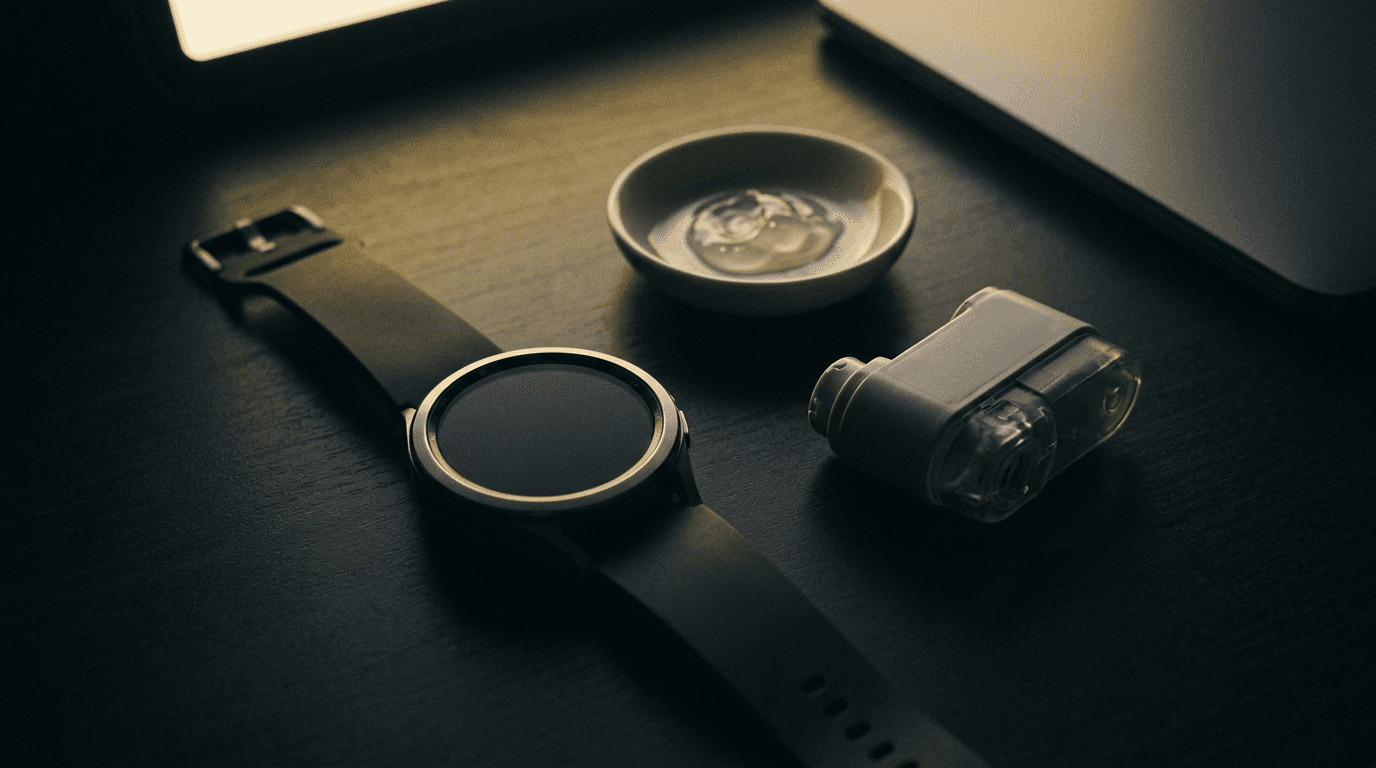
A continuous glucose monitor, or CGM, is a coin-sized patch you stick on the back of your arm. A hair-thin filament sits just under the skin and measures glucose in interstitial fluid every few minutes. The data travels to your phone, and an app draws a squiggly line of your last eight hours. Abbott’s Lingo is one of the newest over-the-counter options, aimed at people who are not on insulin but want to see their glucose in real time. It lasts two weeks, needs no charging, and costs about fifty dollars a sensor. Applying it is easier than it sounds—one push and the inserter does the work—and the adhesive holds through showers and sweaty workouts.
How it works (in plain language)
The sensor uses an enzyme that reacts with glucose and produces a tiny electric current. That current gets converted into a glucose number, but the number is a translation, not a direct measurement. Because the sensor sits in interstitial fluid, there is a lag of five to fifteen minutes behind blood glucose. The app smooths the lag with algorithms, so the line you see is an educated guess. The industry measures accuracy with a statistic called MARD—mean absolute relative difference—and modern CGMs claim single-digit MARDs. In practice, that means the sensor is usually within ten percent of a lab draw. For spotting a post-meal rise or an overnight dip, that is plenty. For making a precise dosing decision, it can still be off enough to matter. As one user told IEEE Spectrum, “I don’t care about MARD. I want data that is reliably actionable.”
Why it matters for movement and health
For someone with diabetes, a CGM replaces finger pricks and reveals patterns no occasional check can catch. It can show how a morning walk blunts a breakfast spike, or how a stressful commute nudges glucose upward. For the rest of us, the value is less clear. A healthy body keeps glucose in a tight range without help, and the spikes a CGM flags are usually normal and brief. Seeing a spike does not mean you are broken; it means your pancreas did its job. The risk is that a stream of numbers turns eating into a performance metric. You might start avoiding an apple because it bumps the line thirty points, even though that bump is harmless. The device is a mirror, not a coach. Use it to learn one or two patterns—like how a protein-first breakfast steadies your morning—and then put the mirror away.
Open caveats
Accuracy drifts. Compression lows—when you lie on the sensor—can fake a hypoglycemic event and wake you with a false alarm. The first and last days of a sensor’s life are often the noisiest. And the numbers you see are not the whole story; a CGM cannot tell you about insulin sensitivity, inflammation, or how your liver is releasing stored glucose overnight. Privacy is another open question. Most CGM apps collect and store your glucose data in the cloud, and while the companies promise not to sell it, the line between research partnership and data brokerage is thin. Finally, noninvasive alternatives are coming. MIT researchers recently showed a Raman-based device that reads glucose through the skin without a needle, with accuracy similar to commercial CGMs in early tests. If that technology shrinks from a cellphone-sized prototype to a wearable, the filament-under-the-skin era may look temporary.
FAQ
Is a CGM worth it if I’m not diabetic or prediabetic?
Probably not long-term. You’ll learn that your body handles carbs just fine, and the data quickly becomes noise. A one-sensor experiment can reveal one or two useful patterns—like how a walk after dinner flattens a spike—but after that, the mirror stops showing you anything new.
How accurate are these sensors really?
Good enough for trends, not for precision. The MARD number sounds impressive, but it’s an average—individual readings can swing further. Compression lows and sensor drift are real, so treat the line as a suggestion, not a lab result.
What happens to my glucose data in the cloud?
Companies say they don’t sell it, but the data often feeds research partnerships. Read the privacy policy closely: if your anonymized data helps build a future product, you’re the product. Until noninvasive sensors arrive, you’re trading a filament in your arm for insights that may not be yours alone.