

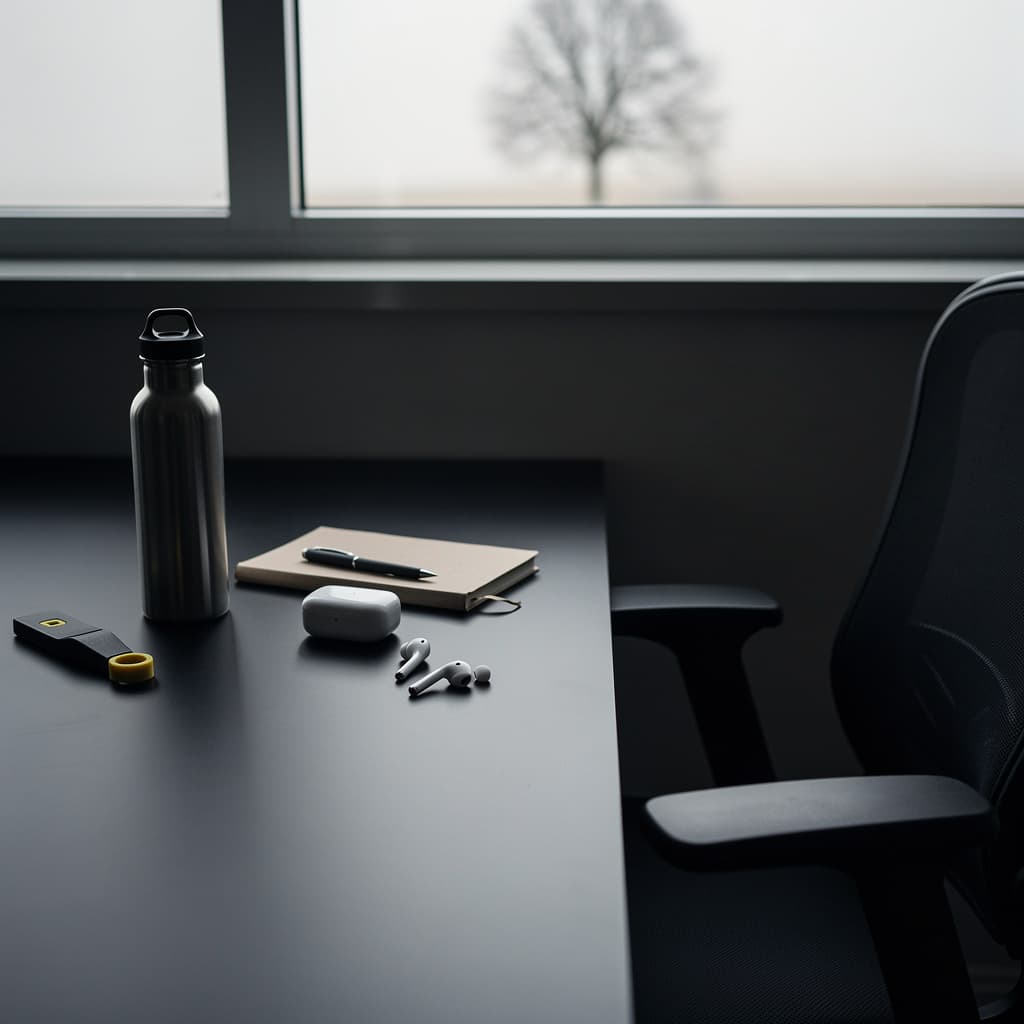
Five small things to make the next two hours less stiff. Shoulder rolls. Neck turns. Sit-to-stands. Window gaze. Water. All under two minutes. All doable without leaving your workspace.
1. Roll your shoulders backward five times
Takes twenty seconds. Sitting hunched over a keyboard shortens your chest muscles and overstretches your upper back. Rolling your shoulders backward reverses that pattern. Do it slowly. Feel the shoulder blades squeeze together at the top. Exhale on the roll back. If you hear a click, keep going—that's just stuck fascia releasing. Do five rolls, then let your arms hang loose for ten seconds. One decision, removed.
2. Turn your head left to right five times each side
Takes thirty seconds. Neck stiffness builds from holding your head in one position while staring at a screen. Slowly turn your head to bring your chin toward your left shoulder. Stop when you feel a gentle stretch—never force it. Hold for two seconds. Return to center. Repeat to the right. Five each side. If you feel a sharp pain, reduce the range. This move targets the levator scapulae, the muscle that screams after hours of phone cradling or screen leaning. Breathe normally throughout.
3. Stand up and sit down five times without using your hands
Takes one minute. This is a mini squat that wakes up your glutes and hip flexors, which go to sleep when you sit. Stand up from your chair, then sit back down with control—no plopping. Keep your weight in your heels. If you can't do it without hands, use your fingertips lightly on the desk at first. Aim to remove the assist over a week. The hip flexors shorten when seated; this move lengthens them under load. It also spikes blood flow to your legs, which fights the afternoon slump. Five reps. One minute.
4. Look out the window for sixty seconds
Takes sixty seconds. Your eye muscles are designed to shift focus between near and far. Staring at a screen 20 inches away locks them in a cramp. Looking out a window—ideally at something 20 feet away or farther—relaxes the ciliary muscles. Blink fully. Let your gaze wander. Do not check your phone. Do not plan your next email. This is a microbreak for your visual system. If you don't have a window, close your eyes and visualize a distant horizon. The brain responds similarly. Sixty seconds. One reset.
5. Drink a full glass of water
Takes two minutes. Mild dehydration—as little as 1-2% of body weight—reduces cognitive performance and increases perception of fatigue. Desk workers often ignore thirst signals when focused. Keep a bottle on your desk. When you finish the fourth move, fill it and drink eight ounces. Cold water hits harder. This isn't about hydration dogma; it's about removing a hidden drag on your afternoon energy. Two minutes. One glass. Done.
Stack these five moves into a single two-minute block. Do them every hour, or whenever your shoulders creep toward your ears. No app. No timer. Just the next time you hit send.
FAQ
Do I have to do all five moves every hour?
No. Pick the one your body is screaming for. Shoulders up by your ears? Roll them. Eyes burning? Window. The point is to break the stiffness cycle with whatever takes the least friction in the moment.
What if I can't do the sit-to-stand without hands?
Use your fingertips on the desk. That's still a win. Over a week, try to lighten the touch. The goal is to wake up your glutes, not to pass a fitness test.
I don't have a window. Does the eye break still work?
Yes. Close your eyes and picture a distant horizon. Your ciliary muscles relax almost the same way. Or just stare at the farthest wall. The key is breaking the 20-inch screen lock.