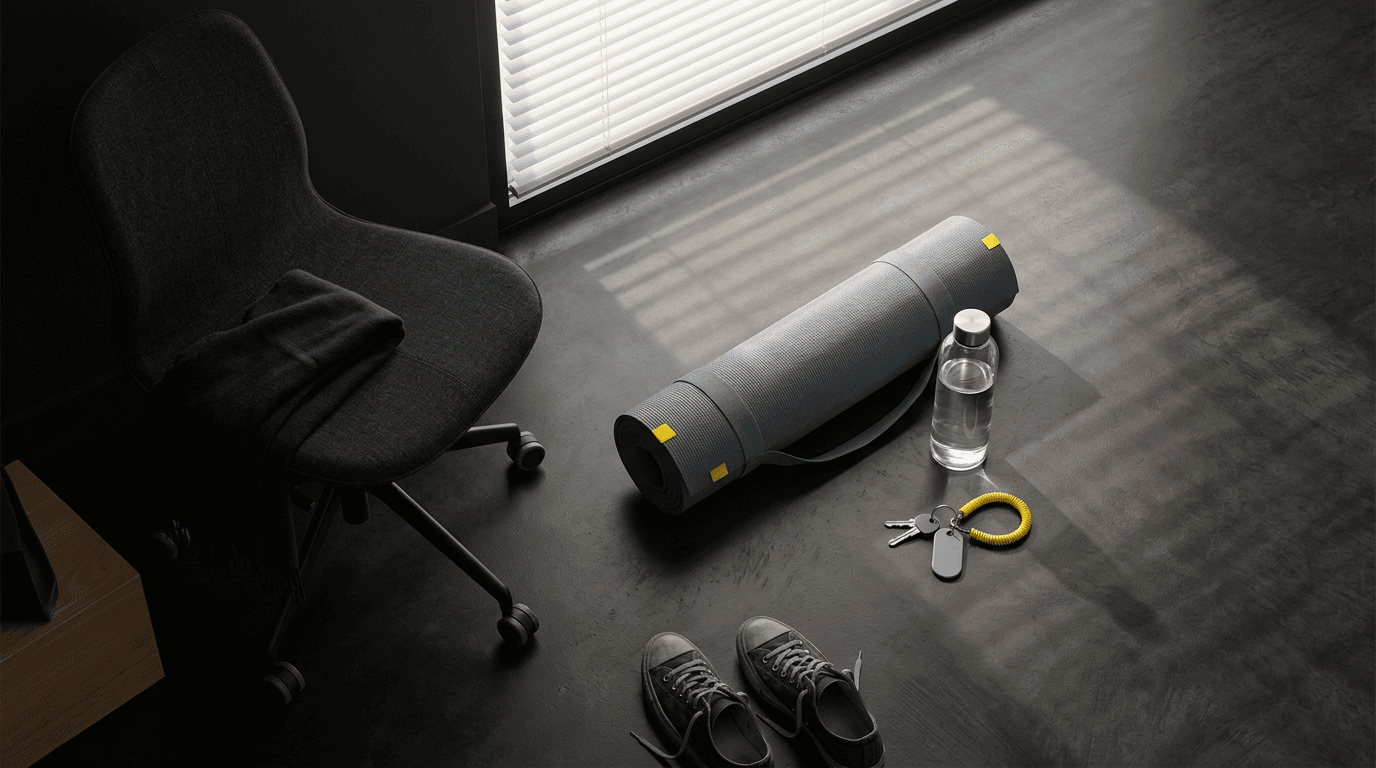


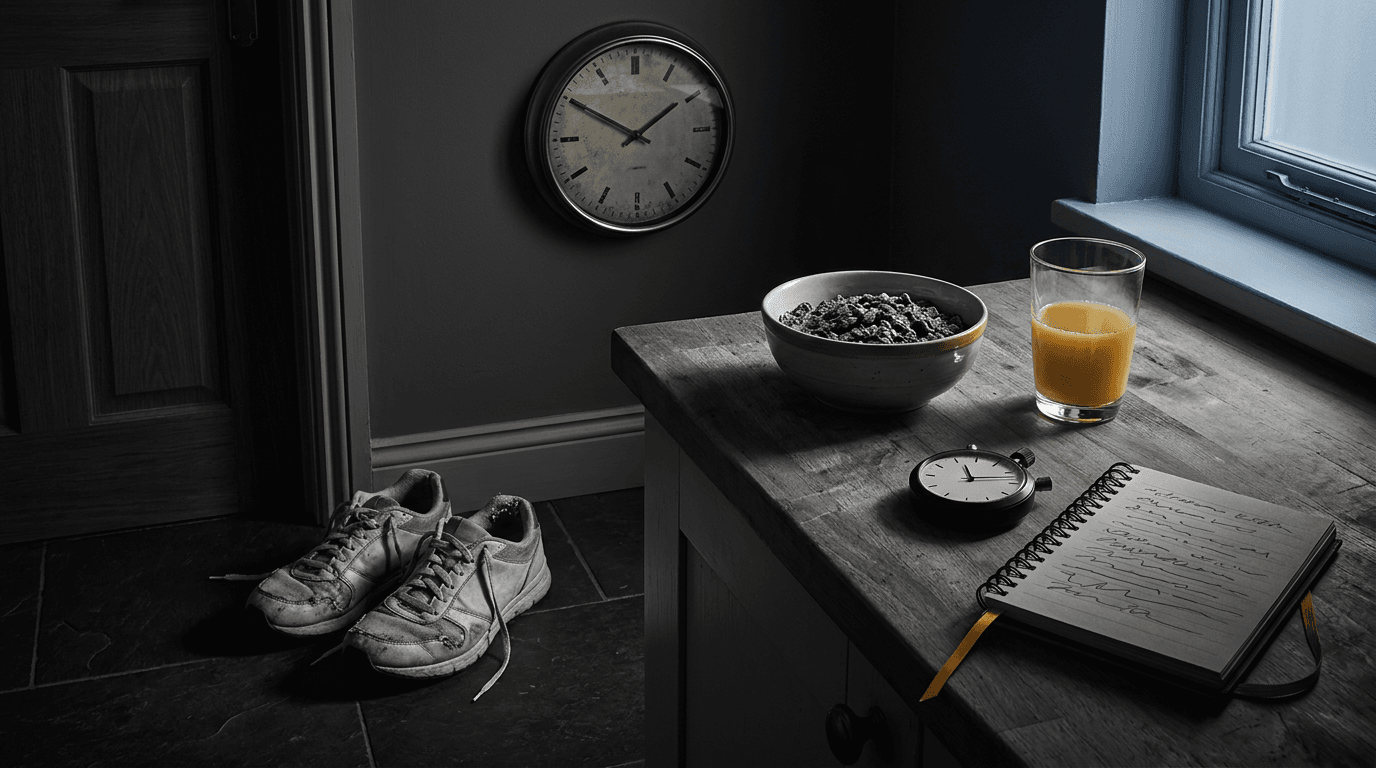
Morning shortcuts are not about doing less. They are about paying less upfront. Same idea, three time budgets: move before the day gets a vote.
The 60-second version
Stand up. Walk to the end of your block and back. That is the whole thing. No shoes if you do not need them. No podcast. No pace target. The bar is touching outside air before you touch a screen. Before: horizontal, scrolling. After: vertical, outside, the day already started on your terms. Cost: sixty seconds, zero recovery. Return: you broke the seal. The hard part of a morning routine is not the workout — it is the transition. This version buys the transition cheap. Want to stack one more thing? Three slow breaths at the door before you go back in. Not for calm. For a clean stop. Past that, returns diminish. Dr. Frates notes that waiting until later in the day lets exercise weigh on you, and you are more likely to find excuses. Sixty seconds removes the excuse before it forms.
The 5-minute version
Same walk, plus a light breakfast you can eat standing up. Cereal, fruit, juice, an egg if it is already boiled. Mayo Clinic suggests finishing breakfast at least an hour before a workout if you are training seriously. For five minutes, you are not training seriously. You are fueling a body that has been fasting all night. Before: empty tank, foggy head. After: blood moving, fuel in. The marginal benefit is not performance. It is that you stopped negotiating. You ate, you moved, you are done. If you plan to exercise within an hour of eating, keep it light — a sports drink counts. Carbohydrates are the point. Five minutes makes the next decision easier. It does not make you an athlete. Fine. You were not buying that today.
The deep version (15-30 min)
Now you have time. Walk fifteen minutes out, fifteen back. Or do short bursts. Harvard Health reports that accumulating several two-minute bouts of vigorous activity was associated with lower risk on several fronts, and fifteen minutes a week of vigorous exercise was linked to an 18% lower risk of dying during a seven-year study period. You do not need thirty minutes to get something. You need thirty minutes to get the version you will remember. Add breakfast with protein. Add daylight on your face. Before: a vague plan. After: a logged morning. The marginal benefit over the five-minute version is real but not infinite. Past thirty minutes you are training, not shortcutting — that is a different article. One note: an observational study cited by Harvard Health found people who exercised in the morning, usually between 7 and 9 a.m., had a lower risk of weight gain than those who exercised later. Observational means a hint, not a verdict. Experiment on yourself.
Pick one
Three budgets, one decision. Sixty seconds if the morning is already lost. Five minutes if you can spare the fuel. Fifteen to thirty if you want the version that compounds. The mistake is picking the deep version on a day that only had sixty seconds in it. That is how routines die. You do not owe yourself the bigger one if the smaller one was the actual decision today. Deciding to move at all is enough. The shortcut is not a compromise. It is the honest price of the morning you actually have. Pick the one that fits your next gap, not the one that sounds best. Then do it again tomorrow, at whatever budget tomorrow offers.
FAQ
What if I only have sixty seconds and I feel ridiculous doing it?
Good — ridiculous is cheap. The sixty-second version is not a workout, it is a transition. You are buying the switch from horizontal to vertical, from screen to outside air. Nobody is scoring it. Do it badly, then do it again tomorrow.
Do I have to eat breakfast to get the five-minute version to count?
No. The walk is the non-negotiable part; breakfast is the fuel add-on. If you are not hungry, skip it and keep the walk. If you plan to train within the hour, keep it light — Mayo Clinic's one-hour rule is about serious training, not a five-minute morning.
Should I just do the deep version every day?
Only if your mornings actually have thirty minutes in them. The deep version compounds when it is repeatable, and dies when it is aspirational. Most weeks, the honest answer is a mix: sixty seconds on the bad days, five minutes on the normal ones, thirty when you have it.