

Your phone's camera has learned to watch you move, and it's less creepy than it sounds. Pose detection is the software trick that turns a flat video frame into a skeleton of joints and limbs, and it's quietly become the backbone of a hundred fitness apps. The marketing will tell you it's like having a personal trainer in your pocket. The truth is more like having a mirror that doesn't get bored — useful, but only if you know what to look for.
What It Is
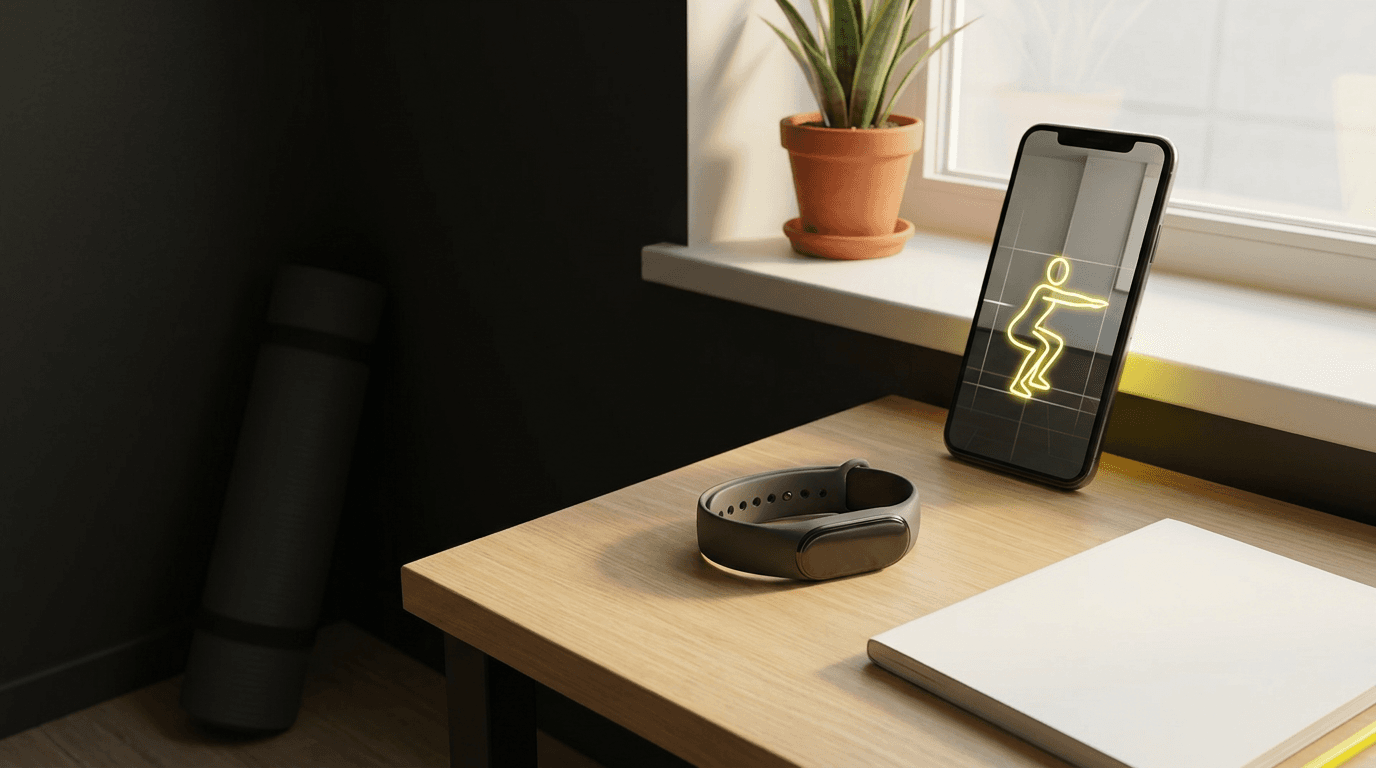
Pose detection is computer vision that finds your body in a frame and maps it to coordinates. Twenty or so key points — shoulders, elbows, hips, knees — get tracked frame by frame, and the software builds a stick figure that moves like you. That stick figure is the raw material for everything else: rep counting, form checks, range-of-motion scores.
The accuracy has improved a lot in a few years. One recent system reported 91.20% accuracy on daytime test sets and 85.12% at night, which tells you something important right away: light matters. Another approach using an infrared array sensor hit 97.75% for fall detection, but that's a different game — a wide-angle sensor watching for a single event, not a phone camera judging your squat depth.
The phone version is the one most people will meet, and it's good enough to catch obvious errors. It is not good enough to replace a thoughtful coach, and it never will be for the parts of training that depend on context.
How It Works (In Plain Language)
The camera captures frames, and a neural network does the heavy lifting. It's been trained on thousands of images of people in all sorts of positions, so it can guess where your joints are even when a limb is partly hidden. The network outputs confidence scores for each joint — a low score means it's guessing, and a good app will tell you to step into better light or move closer.
Two main approaches exist. Top-down detection finds the whole person first, then estimates each joint. Bottom-up detects all the joints in the frame, then groups them into people. The improved YOLO11-Pose model combines both, which lets a single network output multiple people's positions and poses at once. That's useful for a gym buddy checking your form, less useful for a solo lifter.
The output is a stream of coordinates that the app compares to a reference pose. Deviation from that reference becomes your form score. It's a clever trick, but it has a blind spot: the reference is generic, and your body is not.
Why It Matters for Movement and Health
The practical value is in catching what you can't feel. Most people don't notice their knee drifting inward during a squat or their lower back rounding on a deadlift. A camera that flags those deviations in real time is a useful mirror. It gives you feedback at the moment of movement, which is exactly when your brain is plastic enough to adjust.
The research supports the general idea. A review of 118 papers on pose estimation frameworks found the field maturing quickly, with accuracy climbing and processing getting faster. Another survey of activity recognition methods concluded that pose-based approaches are now competitive with older video-analysis techniques. The numbers are real, and they're getting better.
But here's the unsexy caveat: the camera sees joints, not intent. It can tell you your knee moved, not whether that movement was a compensation for tight ankles or a bad habit. It can't see pain, fatigue, or fear. Use it as a tool for form feedback, not as a verdict on your movement quality.
Open Caveats
Lighting is the first thing to go wrong. Nighttime accuracy drops by six points in the study above, and that's with a decent camera. Low light, shadows, and busy backgrounds all confuse the network. Give it a clear backdrop and even lighting, and you'll get a much more honest read.
Privacy is the second. Pose data is biometric data, even if it's just coordinates. Check what the app does with those frames — local processing is better than cloud upload, and on-device inference is becoming more common. If the app needs an account to store your workout videos, that's a red flag.
Finally, treat the score as a relative number, not a clinical reading. Your form score on Tuesday is only meaningful compared to your form score on Friday. If it disagrees with how you actually feel, trust the body. The camera is a tool, not a judge.
FAQ
Can my phone really detect my pose without special hardware?
Yes, but with limits. Modern phones have enough processing power to run pose detection models on-device, using just the camera. The accuracy is good in consistent lighting and with a clear background, but it drops in low light or cluttered scenes. You don't need a depth sensor or a separate device — just a decent camera and a well-lit room.
How is pose detection different from a regular video recording?
A video is just pixels; pose detection adds structure. The software identifies your joints and tracks their movement over time, which allows it to measure angles, count reps, and score your form. A regular video requires you to watch and judge yourself — pose detection automates that analysis, giving you instant feedback.
Is my pose data safe?
It depends on the app. Pose data is biometric, so you should check whether the app processes frames locally or uploads them to a server. On-device processing is safer and increasingly common. Avoid apps that require an account to store your workout videos — that's a sign they're collecting more than they need. Always read the privacy policy.