

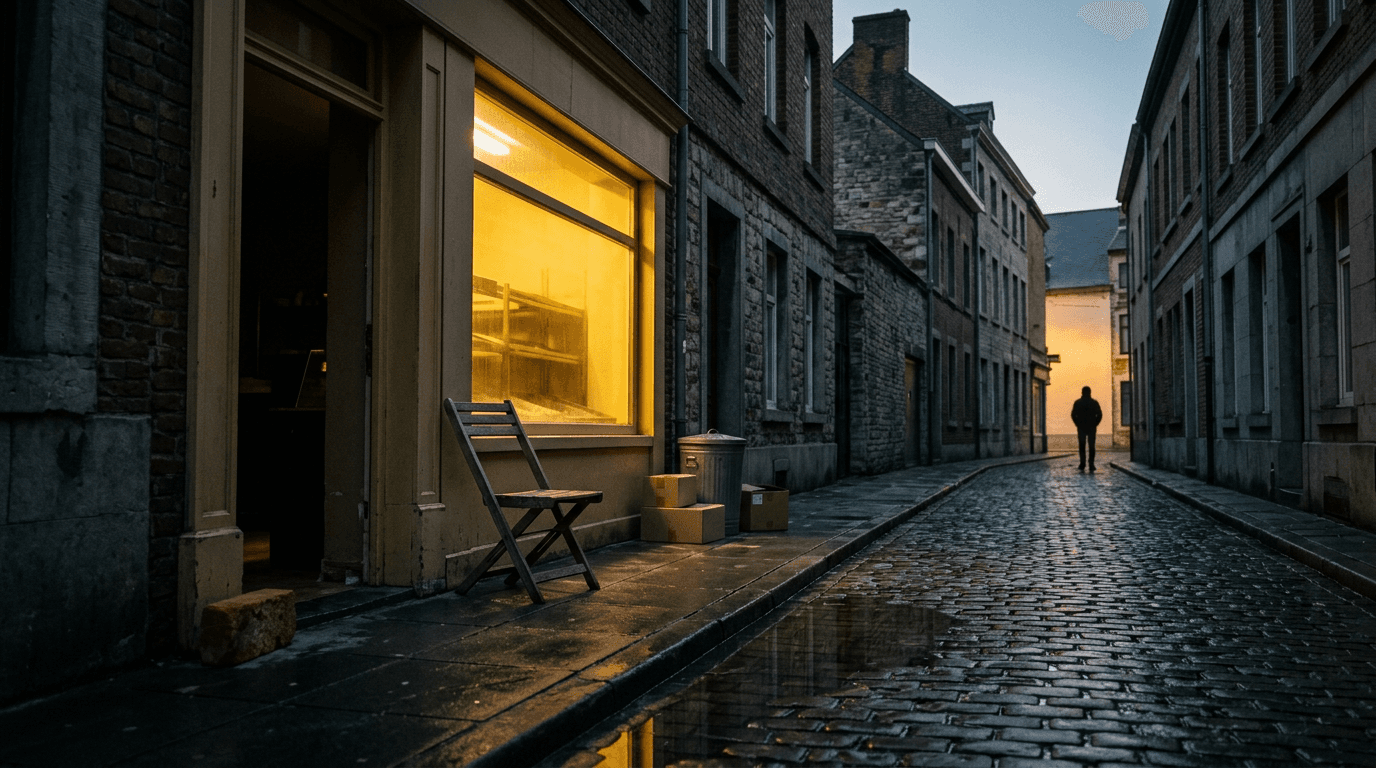
At six forty on a Tuesday the corner of Pine and Ellery is still blue, the sky the color of a dish towel left too long in the wash, and the bakery on the north side has just clicked its shutters up with a sound like a train door closing. The smell of butter reaches the bus shelter before the first bus does. A woman in a gray fleece walks a dog that has clearly done this before and knows which grate to sniff. The streetlight above the crosswalk is still on, though it has nothing left to illuminate.
The corner before the day arrives
This is the hour that belongs to the people who do not call it exercise. A man in a paint-flecked cap carries two paper cups back toward the row houses, held out slightly from his body like a man carrying a birthday cake. The baker props the door with a brick. A cyclist coasts past without pedaling, the only sound the faint ticking of a freewheel. Nothing on this block is optimized for anything. The walker who steps out at this hour inherits the whole thing for free — the bakery light spilling in a yellow parallelogram across the wet pavement, the bus idling with its doors open, yeast and cold air mixing in a way no screen reproduces. There is no app for that part.
What the next hour brings
By seven the block has changed hands. Two delivery scooters park nose-to-curb outside the noodle shop whose sign is missing a letter, and the riders stand in the cold comparing something on their phones. A crossing guard in a fluorescent vest unfolds a chair and sets it at the corner, then does not sit in it. The bakery queue appears — four people, then six — and vanishes the way morning queues do. A man in a suit walks past, hesitates, doubles back.
Circle the block again and you see the same doorway in a different light, literally: the sun has cleared the roofline, and the wet pavement that was blue at six forty has turned a flat silver. The dog is gone. The crossing guard is standing. The brick in the bakery door has been moved to hold the other side. Same block, and not.
What the walker hears and smells
The sounds arrive in layers if you let them. First the low refrigerator hum from the corner grocery, almost inaudible until you stop walking and then suddenly the loudest thing on the street. Then the scrape of a metal chair on tile. Then, from somewhere above, a window sliding open and a radio playing a weather report to nobody in particular. The smell shifts block by block: yeast at the bakery, diesel at the bus stop, the clean wet-stone smell of the alley behind the temple, coffee from the shop with the hand-lettered sign.
A woman waters three pots of geraniums on a second-floor balcony and the water drips onto the awning below like slow applause. A delivery truck reverses, beeping. A screen door slams and a cat appears on the wall as if the slam had summoned it. Texture matters — the grit underfoot at the crosswalk, the smooth worn stone of the temple step, the cold metal of a bus-stop handrail. A short stroll can hold more than a long one if the walker is paying attention; researchers writing about brief walks have made a similar point about how the body responds to movement broken into small pieces.
What the walker carries home
By nine the block has emptied. The crossing guard has folded the chair and gone. The bakery has sold out of the morning's first bake and the woman in the window has closed it. The bus shelter is empty. A man in a green apron sweeps the sidewalk in front of the noodle shop with a broom worn down to the binding. The light is fully horizontal now, catching the dust he raises.
Four visits, four places. The walker who set out for a destination and got one instead has missed the point. The walk was the destination — the bakery light, the folded chair, the geranium water on the awning, the cat, the broom. None of it required a plan. None of it required a step count. The city offered it up at six forty and took it back by nine, and will do the same tomorrow, whether or not anyone comes out to see. If anything here raises a question about your own body or how much walking is right for you, consult a physician before making changes.
FAQ
Do I need to walk at six forty in the morning to get this?
No. The hour matters less than the repetition. Pick whatever hour your block actually changes — school run, lunch, dusk — and walk the same loop twice. The second pass is where the noticing starts, whatever the clock says.
Isn't this just the same walk four times? Why bother?
It is the same block, and that's the trick. The bakery light moves, the queue forms and dissolves, the crossing guard stands up, the brick gets shifted to hold the other door. Four visits let you watch a place change instead of collecting four new places you'll never look at again.
How long should each pass take?
As long as it takes, which on a city block is five to ten minutes at a stroll. Don't lengthen the walk to make it count — lengthen your attention. If you're chasing a distance goal or have joint trouble, check with a clinician about what's right for you.