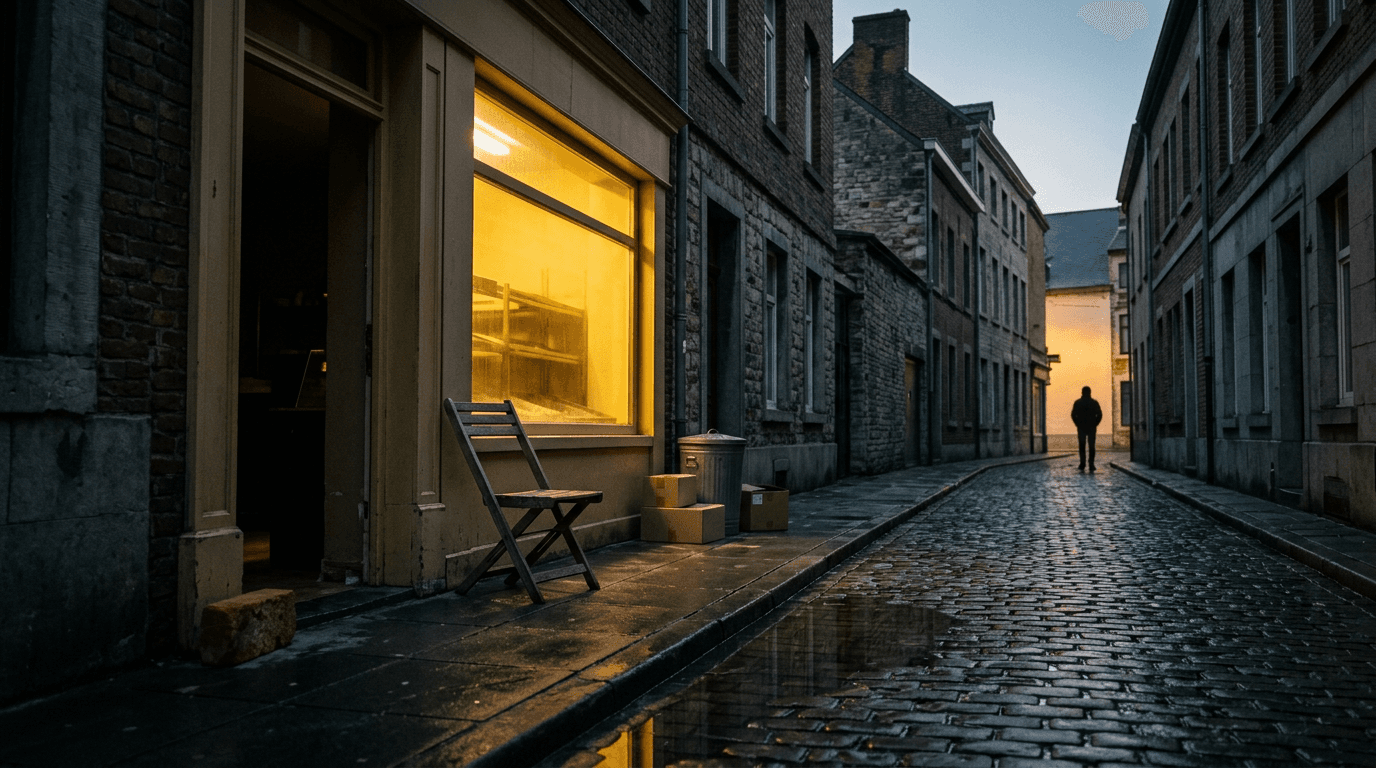


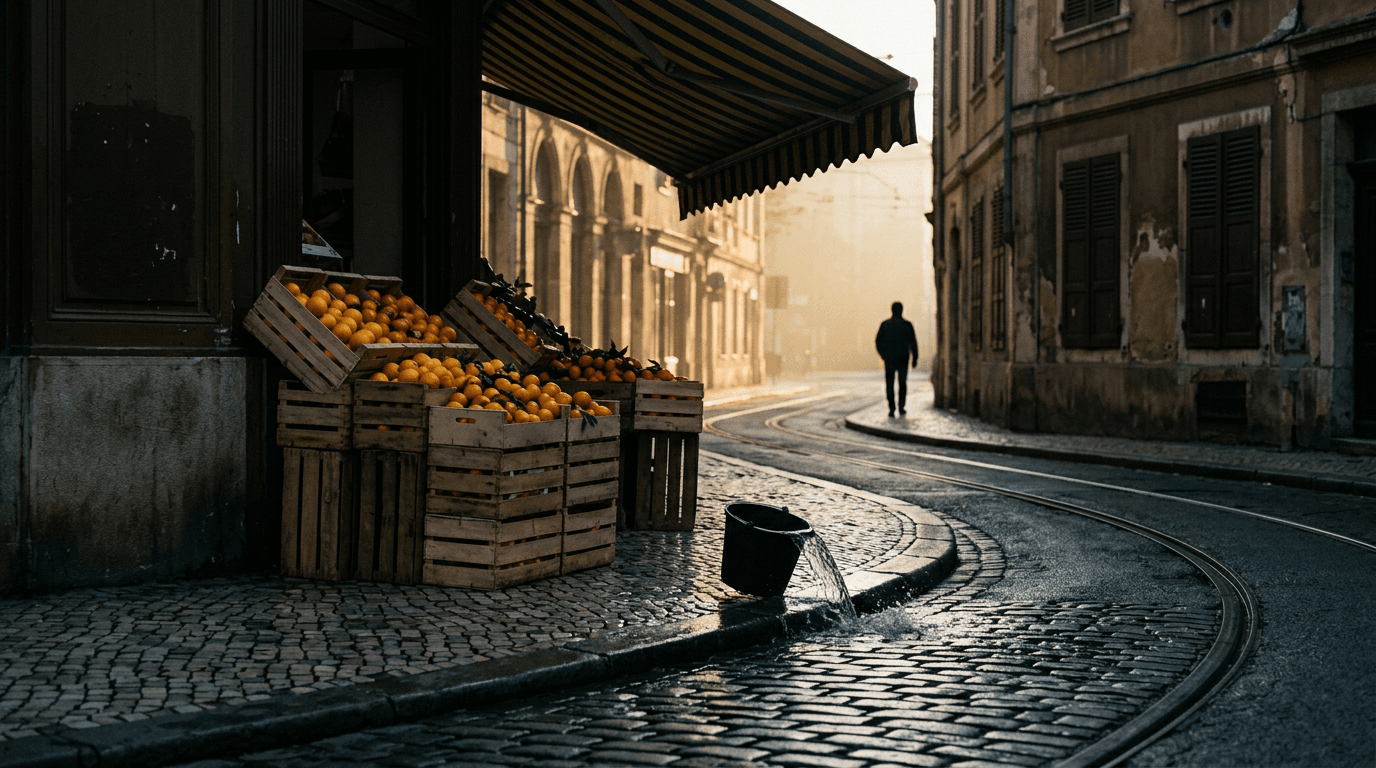
At a quarter past six on a Saturday, the corner where the produce market meets the old tram line is still deciding what kind of morning it will be. A woman in a red apron stacks clementines into a pyramid she has built a thousand times, and the fruit settles with a sound like distant applause. Behind the shutters a radio reads the news to a room with no one in it. The air smells of diesel and wet stone and, from the stall that never puts up a sign, frying dough. Nothing here is asking to be photographed. It is simply happening, at its own pace, for whoever happens to be standing in it.
What unfolds
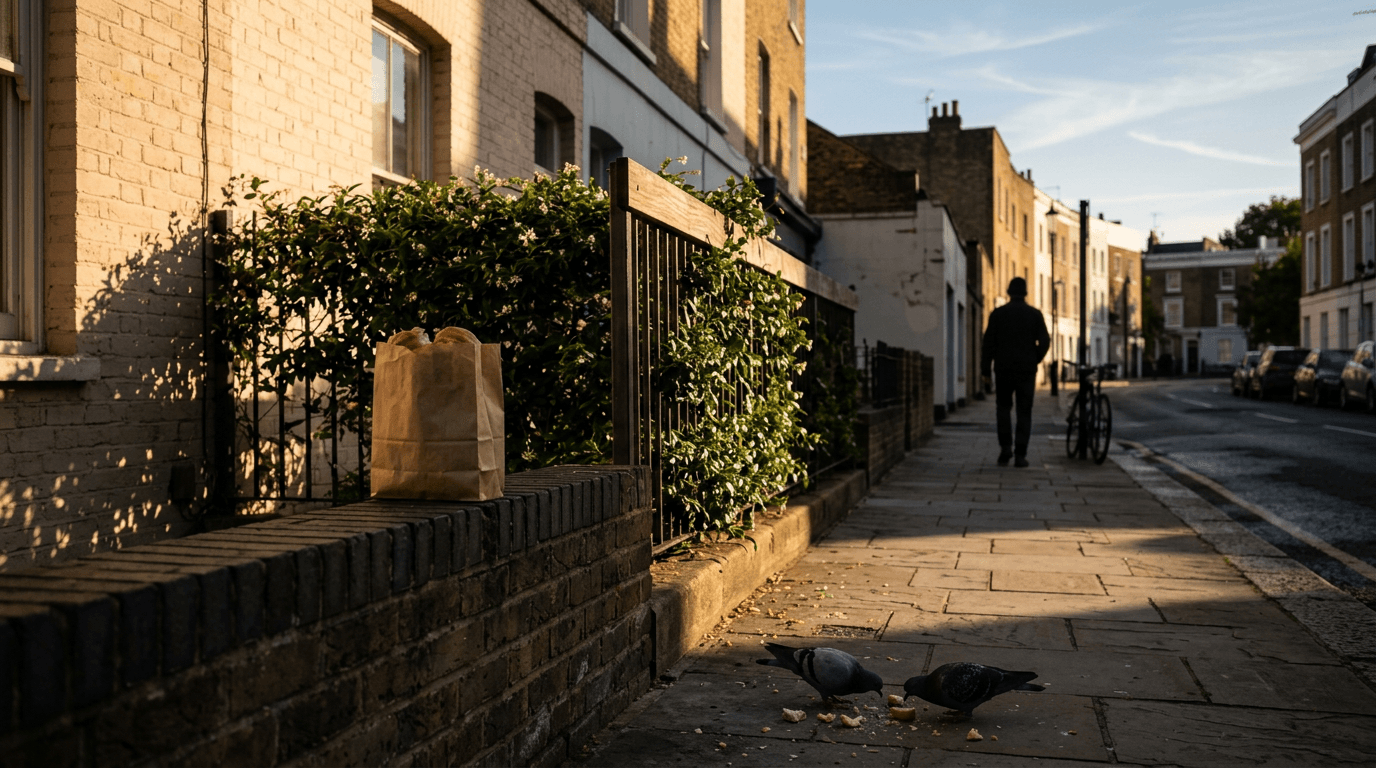
By seven the corner has assembled itself. Two men in tracksuits stretch against the tram shelter, not quite in unison. A delivery scooter threads between the bollards and the flower seller's buckets, and the flower seller does not look up. A dog of uncertain parentage inspects the gutter with the seriousness of a customs officer. Then the first bus exhales at the stop, and a handful of people step down and disperse into the streets like water finding its level. The walker with no destination notices what the commuter cannot: the same corner changes hands three times before nine, and each hand leaves its own weather behind. Walk the same block four times — you have visited four places.
Sensory detail
The bakery two doors down opens at half past, and the smell of butter arrives before the door is fully raised. It reaches the corner in a slow wave and rearranges the morning. Underneath it: the mineral cool of the tram rails, the green bite of crushed stems where the flower seller trims, the warm dust of the fruit crates. Sound arrives in layers too — the metallic complaint of the shutters, a bucket of water thrown across the pavement, two women comparing prices in a language the walker does not speak and does not need to. The pavement is uneven here, and the walker feels every slab through the sole of a shoe. That is not a flaw in the walk. It is the walk reporting back.
A small invitation
The weekend does not require a plan, and the corner does not require a visitor with one. Walking is the most accessible movement most of us have; it asks only that the conditions be safe and pleasant enough to bother with, and it folds itself into ordinary routines without ceremony, as the World Health Organization's guidance on everyday transport keeps insisting. A neighborhood course that residents design for themselves tends to last longer than one handed to them, which is why the age-friendly city plans in Seoul spent their effort on streets people actually wanted to walk. So the invitation is modest. Leave the phone in the pocket. Choose the corner nearest your own door and arrive before the shutters are fully up. Stand there for the length of one cup of coffee and let the street introduce itself. If walking raises a personal health question — a knee, a heart, a balance that has changed — consult a physician before you make it a habit.
FAQ
How early do I actually need to be out?
Earlier than feels polite. The corner I wrote about belongs to the people who work it until about half past seven; after that it belongs to the people passing through. If you want the first version, set the alarm for the hour you would normally still be negotiating with.
What if my neighborhood has no market or tram line?
Then it has a bus shelter, a laundromat, a school gate, or a bakery that opens at an hour you have never seen. The point is not the produce. The point is arriving somewhere ordinary before it has finished assembling itself.
Do I need to leave my phone at home entirely?
No — pocket is enough. The rule I keep is that nothing gets photographed until after the coffee. By then you will have noticed that the interesting part was never the picture.